
Opening a familiar repository should be an uneventful start to the day. At cryptocurrency companies investigated by Google, a change in the repository’s coding assistant settings meant that starting a session could download a backdoor. For the developer, the morning routine looked the same. What the workstation had permission to do was a different story. [1]
Two findings in Google’s November 16 threat tracker belong in the same investigation. A coding assistant can run with a developer’s authority, and the model key it uses has a resale value even if the attacker never touches customer data. One incident may first appear as a repository change. Another may first appear as an invoice. [1] [5]
What Google saw in twelve months
In November 2025, Google Threat Intelligence Group (GTIG) described malware that called a language model while it ran. One family was experimental. Another had been observed collecting information in an operation. By the following September, Mandiant had investigated an operator who used an agent inside an already compromised cloud environment to harvest credentials in under six hours. The clock started after the initial compromise. [2] [3]
The 2025 examples were PROMPTFLUX and PROMPTSTEAL. GTIG classified the former as experimental and observed the latter in operations. In September 2026, Mandiant was able to reconstruct something different: the time between an operator assigning a task in a breached environment and the harvesting of thousands of third party credentials. In a separate finding, a dashboard called Recon held more than 23,800 harvested secrets, including cloud credentials and AI service keys. GTIG did not attribute that dashboard to the operator in the six-hour case. [2] [3] [7]
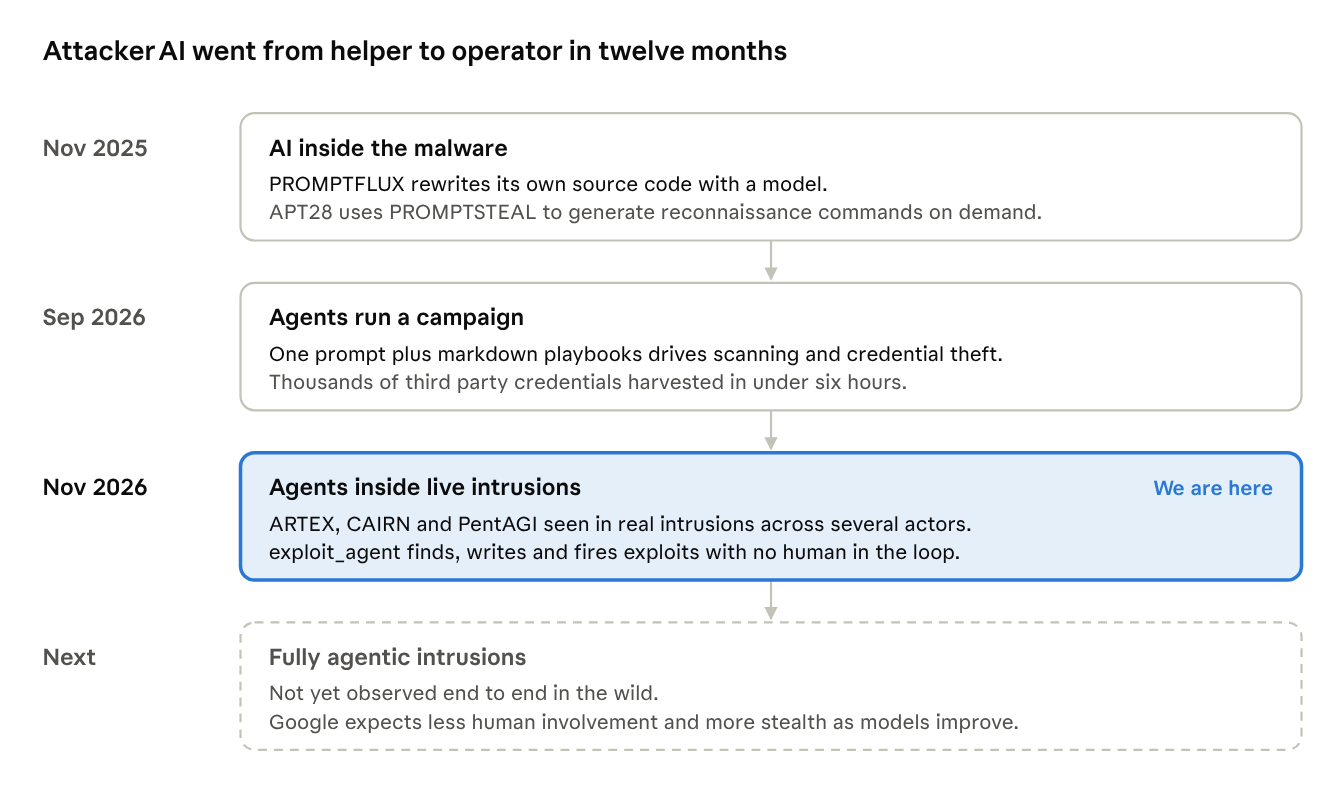
- Nov 2025
- Google documents model calls inside malware.
- Sep 2026
- An operator uses an agent to harvest credentials after a cloud compromise.
- Nov 2026
- Investigators observe frameworks in several live intrusions.
- Forecast
- An intrusion run entirely by agents remains a prediction in this report.
The November 16 report identifies several groups using publicly available frameworks. A useful distinction for an incident review is what the investigators actually found. Software on a server establishes a capability. An event log tied to an account can establish that someone used it. [1]
How Oktsec Radar follows an incident
Oktsec Radar is our public security advisory desk. For each case, we record which systems are affected, what evidence supports the priority and what the owner can do. Each advisory links to the underlying reports and keeps a dated history of changes. Two entries show why that history matters here.
ARTEX. On November 14, we updated the advisory with findings from Google, Mandiant and Cisco Talos. For a team that found an exposed cloud secret, revocation is the first task. The update widened the investigation to application credentials and roles added during the exposure window: either could preserve access after the original secret was revoked. Read the ARTEX response checklist.
PHP2Shell. An application owner can check the corrected release for their PHP branch. A network team running an appliance that embeds PHP needs the appliance vendor’s firmware guidance. The advisory covers both and dates the log review back to October 17, when AWS sensors first recorded attempts. Check affected products and fixes in Radar.
What the framework evidence establishes
| Framework | What investigators observed |
|---|---|
| ARTEX | Used in live intrusions. Google SecOps released detection rules for characteristic behavior and traffic volumes. See the Oktsec review of cloud and identity evidence. |
| CAIRN | GTIG observed intrusion activity involving this multiagent framework against US aerospace targets. |
| PentAGI | From late August to early October, an operator used a modified version for reconnaissance across organizations in Asia. The report documents scanning during that period. |
| CyberStrikeAI | GTIG observed experimentation with this orchestration framework. The report gives no victim count for it. |
| HexStrike AI | Investigators also observed experimentation with this MCP framework. That finding alone does not establish an intrusion at an organization using MCP. |
| Agent Zero | GTIG identified threat actor use of this general agent framework. It did not attribute a particular victim outcome to it in the tracker. |
| ZeroHollow | An inference service identified in threat actor activity. This entry concerns access to a service, distinct from finding software installed on a victim’s host. |
| exploit_agent | Investigators recovered a custom framework on exposed staging infrastructure alongside victim data. The framework automated a discrete task without an approval step. [1] |
- Recovered
- Framework configuration and data from victims on the same infrastructure.
- Documented
- Automation of a discrete exploitation task without a person approving each action.
- Still open
- Which actions succeeded at each victim, and where operators intervened elsewhere.
exploit_agent. A victim’s own service and identity logs are needed to reconstruct their incident. [1]Four days from PaperCut disclosure to a widespread campaign
In August, researchers produced working demonstrations for two PaperCut vulnerabilities within a day of disclosure. Four days after disclosure, GreyNoise observed a campaign against hundreds of organizations. It assessed that the operator likely used language models. Those dates matter to anyone responsible for an exposed print server. A ticket scheduled for the following week could still be open after the campaign had started. [1]
PaperCut issued its advisory on August 27. GreyNoise traced the August 31 campaign involving CVE-2026-81578 and CVE-2026-82078 to at least 440 compromised installations at 395 identified organizations in 48 countries. Education accounted for 204 installations. GreyNoise found evidence of credential harvesting on 280 installations and domain administrator access at 12 organizations. A print server and the directory it authenticates against therefore belong in the same investigation. Patching the server closes only one of those tasks. [6]
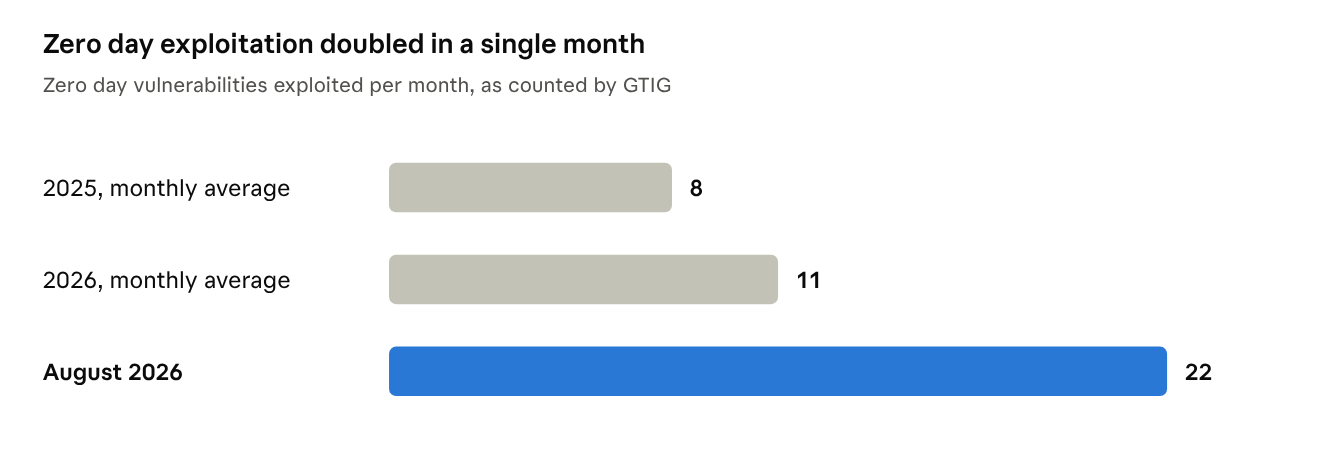
Zero days exploited in the wild, as counted by GTIG
- 2025 monthly average
- 8
- Jan–Aug 2026 average
- 11
- August 2026
- 22
October’s PHP disclosures posed another problem. Information about the fixes circulated before the official October 21 release. Afterward, defenders faced hundreds of purported proofs of concept that did not work. For a service owner, checking the deployed PHP version and confirming that the corrected build is running are better uses of that window than evaluating every claim. [1]
The two PHP identifiers were CVE-2026-109618 and CVE-2026-109619. AWS traced attempts in its MadPot sensors to October 17, before the October 21 release. For teams choosing a log retention window, that four-day difference matters. The volume of demonstrations published after the fix is a poor guide to when to start the search. Our PHP response notes and the AWS observations.
What changed in the developer’s repository
Google attributes the cryptocurrency intrusions to suspected MIDNIGHT NEPTUNE activity. The investigation connected recruitment lures, changes in internal repositories and the SOMBERMEME backdoor. The useful question for a repository owner is concrete: which developers opened this project after the settings changed? The answer defines a set of machines and credentials to investigate. [1]
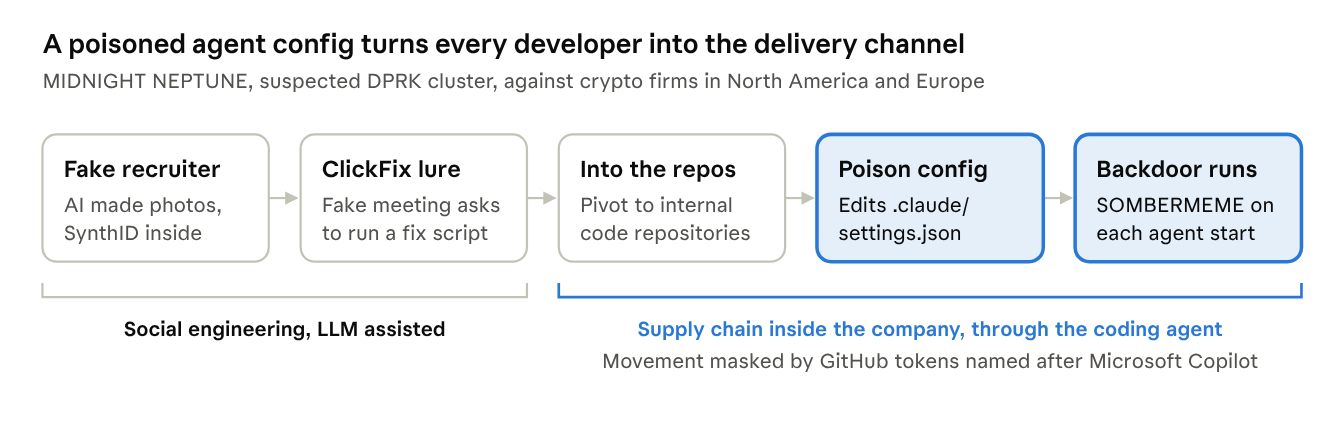
- First contact
- Recruitment lures brought developers to a fraudulent meeting site.
- Repository
- Changes to the coding assistant’s settings reached an internal project.
- Workstation
- Starting a session triggered a backdoor download. Endpoint records can establish whether it ran.
Start with the settings change and its author. Preserve the previous revision, the review record, session start times, endpoint process events and outbound requests. Use timestamps to identify the sessions that could have loaded the changed configuration. Check the actual issuer and owner of any service credential used in that period. A display name is weak evidence of ownership.
Google’s September report describes a related problem in the DUSTMAKER supply chain campaign. Development tools were among the affected surfaces, and a package contained text intended to influence automated reviewers. An independent approval for executable configuration gives a maintainer a concrete decision to audit, even when the automated review returns a clean result. [3]
In the MIDNIGHT NEPTUNE cases, Google found SynthID watermarks in recruiter profile pictures used to approach cryptocurrency companies in North America and Europe. The watermarks support a narrow conclusion about how those images were made. Attribution also depended on what happened after contact. A review of that period should include newly issued tokens and their owners, even where a token’s display name resembles a familiar development tool. [1]
The DUSTMAKER investigation involved a different group, UNC6780, also known as TeamPCP. Its reach included Claude, Cursor and VS Code working environments. Reviewing every affected repository revision is valuable, but package history and the developer’s local settings can explain a change that never appeared in the organization’s own pull requests. [3]
When the first incident report is a cloud bill
A stolen model key can have value even when its owner’s application stays online. Mandiant documented fraudulent usage above US$100,000 in one day in some incidents. In the most severe cases, accumulated abuse reached US$1 million before containment. These are observed losses at the high end of its investigations. Neither number estimates the typical cost of a stolen key. [5]
LLMJacking is the unauthorized use of someone else’s model or compute allowance. A reseller can aggregate access from several accounts. A finance team may see an invoice total while the platform team sees individually valid API requests. To connect the two, keep a record of the project, principal and key associated with each usage stream. Check whether new identities, permissions or GPU workloads appeared during the billing interval. [5]
Revoking the exposed key is only one part of recovery. Establish when usage stopped, look for identities created during the incident, and verify that the replacement credential belongs to the intended workload. Keep the provider’s usage export with the incident timeline so finance and security can reconcile the same period.
A gateway incident can involve more than one account
Mandiant investigated cases across finance, retail, transportation and technology in North America, South America and Asia Pacific. In one LiteLLM case, CVE-2026-40217 affected the boundary between a limited inference key and gateway administration. Incident scoping should include the credentials managed by the gateway, its administrator history and the provider’s usage records. Elsewhere, two actors used the same exposed credentials on the same day. Investigators attributed millions of API calls in roughly 24 hours to one botnet or proxy service. [5] [1]
There is a separate LiteLLM case in Radar for teams that ran version 1.107.0. On October 21, malicious packages and container images were distributed through release channels. The response depends on where those artifacts ran and which credentials they could read. Even a cached image executed after withdrawal belongs in that review. Check the affected LiteLLM artifacts and recovery steps.
What the resale prices measure
GTIG found advertised prices ranging from US$0.10 to US$25 per million tokens in the markets it studied. Access tier, model and context length affected the offer. Some sellers charged a monthly fee instead. The advertisements establish a market for unauthorized access. They cannot tell a victim what it owes: only the provider’s billing and usage records can do that. [1] [5]
Influence operations, phishing and espionage
The same tracker documents other uses of models, with different consequences for defenders. Influence operators produced material for distribution. Phishing services added assistants for their customers. Espionage actors processed stolen documents. An increase in generated content measures production capacity. To assess the effect of an influence campaign, investigators still need evidence of reach and audience response. [1]
In August, Google examined an influence platform aimed at audiences in Europe and the Middle East. In a separate investigation, a contractor was developing a platform designed to manage more than 100,000 accounts. That number describes design capacity. It gives no count of active accounts or people persuaded. In ecommerce fraud, the Chinese-language service Jieyou added an assistant in June, three months after investigators first saw the service. [1]
GTIG also described LEAKY CASTLE using models to analyze stolen material and produce intelligence reports. The tracker records continued use by Iran’s CALANQUE ION for reconnaissance and social engineering, and by North Korean IT workers during recruitment. In separate espionage cases linked to the PRC, investigators saw unauthorized file transfers involving AI platforms. For a network team, the provider’s domain in a proxy log is only the beginning: the approved account, destination tenant, transfer size and initiating identity are the details that make the event interpretable. [1]
What the cases mean for an agent owner
A repository reviewer, an identity administrator and a finance analyst can each see a different piece of the same exposure. The reviewer knows which configuration was approved. The administrator knows which principal could act. The analyst knows when usage diverged from the budget. Give all three a common identifier for the workload. Without it, revoking a key can stop the bill while leaving the repository change that exposed it in place.
A model’s review is useful evidence, but the DUSTMAKER case illustrates its limits when the reviewer reads content controlled by the package author. Decide in advance which actions require independent approval. Then retain the request, the policy decision, the account involved and the destination service’s response. Those records let an investigator distinguish an attempted operation from one that completed.
What to review this week and this quarter
This week
- Repository owners. Inventory startup settings, hooks, skills and MCP definitions. Assign reviewers to changes that alter execution or expand permissions. Check that branch protection actually requires their approval.
- Identity and platform teams. Match each agent credential to an owner, workload, scope and expiry. Review privileged tokens added recently. Rotate exposed credentials and check that the old values have stopped working.
- Cloud and finance teams. Set usage alerts per project and model. Send a test alert to the person who can suspend consumption out of hours. Identify who can revoke a gateway credential without disabling unrelated services.
- Service owners. Check exposed services and AI gateways against vendor advisories. Record the active version and the time the fix took effect. Keep a separate task for reviewing access before that time.
This quarter
Pick one production workflow. Follow its identity from the developer’s session to the tool call and the destination service. Check where an out-of-scope request is denied, who can approve an exception and how an investigator would recover the decision. In a tabletop exercise, have a second person revoke the agent’s access using the records the first person left behind. Measure the time to containment.
Run that exercise twice: once for a workstation opening an unfamiliar project, and once for a model key still generating charges after a rotation. For the first, check whether the employee can verify the request through a known contact and whether the endpoint team can identify affected sessions. For the second, ask the cloud owner to identify additional principals, disable remaining access and confirm the stop time in provider logs.
Use the exercise to set a review period for exposed services. Record the first exploitation known to responders as well as the vendor’s disclosure date. Restrict AI service egress by workload and destination where supported, and verify that responders retain the underlying logs when a provider or model changes.
Where Oktsec fits
| Exposure | Oktsec’s scope | Other owners |
|---|---|---|
| Repository settings | Control inventories agent components. Aguara can inspect skills, MCP configuration and packages. | Maintainers approve executable settings. Endpoint teams reconstruct what actually ran on each machine. |
| Tool calls | Control evaluates the agent’s identity, permissions and content before forwarding a call. It can flag, hold or block the request. | The destination enforces its own authorization. Its records show whether a permitted operation succeeded. |
| Changes to tools | A change in the hash of an MCP tool schema flags a changed interface. Signal can assess a component before installation. | Owners review the change and decide whether to trust the new version. A matching schema cannot establish that implementation behavior stayed the same. |
| Credentials | Scoped agent identities and expiring delegations limit which actions a workflow can request. | The cloud account owner controls provider keys, IAM, GPU quotas and spend alerts. |
| Incident evidence | A reviewer can verify the integrity of signed, chained records offline with the trusted public key. | Responders correlate those records with endpoint and cloud events, including activity outside the gateway. |
| Exposed services | An Assessment tests a defined system and records what was reachable during the engagement. | Service owners apply patches, verify the running build and maintain continuous monitoring. |
| Social engineering | Training for technical teams and leaders can rehearse how to verify a recruiting request and escalate an unexpected download. | Security operations owns endpoint containment. The business owner decides when to resume the workflow. |
| Influence operations | Outside the scope of these Oktsec controls. | Platform integrity teams investigate coordinated accounts, distribution and audience impact. |
What we’ll track in Radar
The table records our November 18 baseline. The last column sets out what evidence would warrant another look. For changes already verified during a reporting week, the Radar weekly recap preserves that week’s cutoff and links to the advisories for subsequent updates.
| Indicator | November baseline | Evidence that would change it |
|---|---|---|
| Agent autonomy | GTIG documented automation inside live intrusions. | A victim timeline that identifies operator decisions, or their absence, across the entire intrusion. |
| Framework visibility | Google published behavioral and volume detections for ARTEX. | Incident records that show how detection coverage changed on the same class of monitored systems. |
| Repository configuration | MIDNIGHT NEPTUNE affected coding assistant settings. DUSTMAKER affected development environments through packages. | A separate investigation that ties a change in another client or widely used project to execution on developer machines. |
| Patch window | Four days from PaperCut’s advisory to the widespread campaign. | Several independent vendors reporting widespread exploitation within 48 hours of disclosure. |
| Zero days exploited | GTIG counted 22 in August. Its monthly average through August was 11. | Several subsequent months above that average, measured using the same collection method. |
| AI gateways | Mandiant documented exploitation of LiteLLM in a billing abuse investigation. | A vendor or incident responder confirms exploitation of a different gateway vulnerability. |
| Stolen model access | GTIG saw advertised prices of US$0.10 to US$25 per million tokens. | Comparable offers for the same model, access tier and billing unit moving over time. A price change alone cannot establish how many keys were stolen. |
| AI platform abuse | GTIG observed espionage activity involving model providers’ file services. | Another provider or incident responder publishes evidence of unauthorized transfers and the logs needed to identify them. |
Sources
- Google Threat Intelligence Group, November 16, 2026. Agentic Threat Activity Crosses a Significant Threshold.
- GTIG, November 5, 2025. Advances in Threat Actor Usage of AI Tools.
- GTIG, September 8, 2026. From Prompting to Autonomy.
- GTIG, September 30, 2026. Vulnerability Discovery and Exploitation Trends in the AI Era.
- GTIG and Mandiant, November 2, 2026. The Rise of LLMJacking.
- GreyNoise, September 9, 2026. Global campaign against PaperCut NG/MF. Incident timeline, organization counts and sector breakdown.
- Cloud Security Alliance, September 9, 2026. The six-hour credential harvest and the separate Recon dashboard finding.