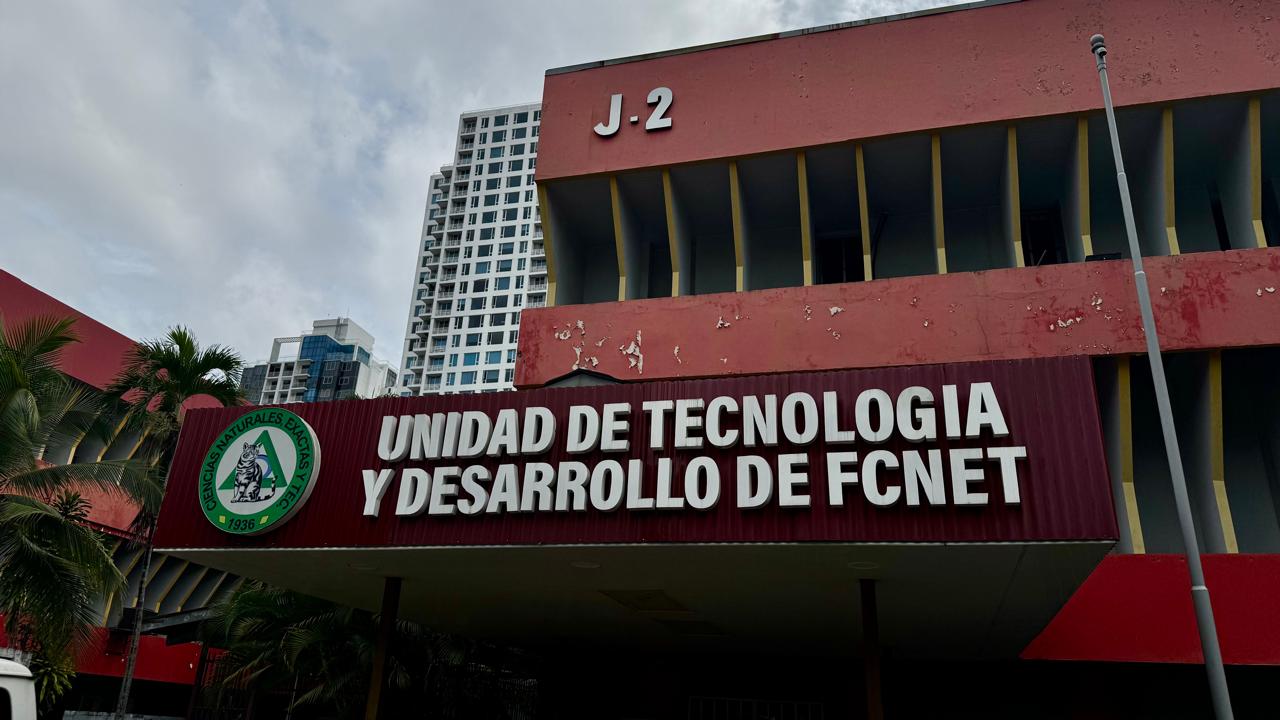
Panama City, October 12, 2026. Gustavo Aragón, founder of Oktsec, visited the Facultad de Informática, Electrónica y Comunicación (FIEC) at Universidad de Panamá at the invitation of its dean, Gustavo Díaz. The conversation focused on preparing technology students to assess the security of AI applications and the systems connected to them.
Following the meeting, Aragón will return to Panama from November 16 to 20 to give a talk and practical workshops as part of CIIECOM, the Congreso Internacional de Informática, Electrónica y Comunicación. The faculty’s congress brings students, researchers and professionals together to exchange work in computing, electronics and communication.
What students will work on
Oktsec has proposed three exercises for the workshops. The content and technical prerequisites will be agreed with the faculty.
Read a record. Who can change it?
Give an agent a task that requires reading data, then check whether it can also modify or export records. Narrow its permissions and repeat the test to see whether the restriction holds.
A document tries to redirect the task
Ask an assistant to summarize a document containing a malicious instruction. Observe the attempted action, identify which input it trusted and test a control that limits the damage.
Check what an application brings with it
Review a tool or dependency before adding it to an application. Inspect its source, requested access and network destinations, then document what needs investigation before deployment.
These exercises connect technical testing with AI governance: deciding who owns a system, which actions need approval and what evidence should be kept. Students would work with prepared cases and test data, documenting both the problem and the limits of the control they tested.
Cybersecurity, career choices and entrepreneurship
The talk, Ciberseguridad en la era de la IA: riesgos reales, nuevas oportunidades — “Cybersecurity in the age of AI: real risks, new opportunities” — will combine security examples with questions about entering the field. Aragón will draw on more than 20 years in technology, including 14 as a CTO and seven years building a business in Brazil.
At Brelo, which he co-founded, he led the development of patented technology that allowed mobile phones to serve as collateral for credit. That experience gives students a case to discuss beyond the technical implementation: identifying a customer problem, building a product and making decisions as a founder in another country.
The session will also address how to practice security research, write a useful finding and choose a first project. It is designed as a conversation with time for questions, including from students with no previous cybersecurity experience.
The original talk was planned for an audience of more than 100 students in the university auditorium. It was suspended after the October 9 earthquake and will now be presented during CIIECOM. Session dates, rooms and registration details will be shared once the program is finalized.
Research and open source as teaching material
Oktsec’s work spans security assessments, AI governance, controls on agent actions and AI supply chain security with Signal. Aragón’s research includes more than 250 security findings reported to vendors through security programs and direct disclosure.
The company’s open-source projects also give students code they can study and run: Aguara inspects AI agent tools, skills and dependencies for security risks, while nanostack provides a structured workflow for AI-assisted development. Students can inspect the code, reproduce a test and propose a change.
Aragón is an Ambassador for the Agentic AI Foundation, part of the Linux Foundation. At the OAS’s ACE Barranquilla, he signed letters of intent with academic and research institutions, including AudacIA at Universidad Simón Bolívar and the University of Illinois, to explore collaboration in cybersecurity, AI and training.
About FIEC and Universidad de Panamá
FIEC brings together computing, electronics and communication programs at Universidad de Panamá. The university is the country’s largest public university by enrollment, according to INEC’s 2024 figures. FIEC recorded 1,776 undergraduate students at Ciudad Universitaria in the first semester of 2026.
Invite Gustavo to your university or company
Organize a talk on cybersecurity, AI or entrepreneurship, or a practical workshop for your team. Tell us about your audience, the topic and your preferred format.
Related: The original Universidad de Panamá speaking invitation. Congress background: CIIECOM’s official call for contributions.